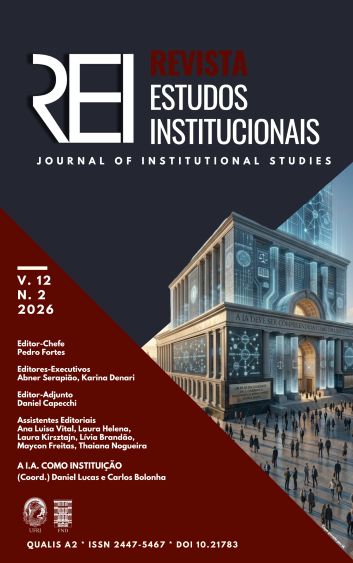
A IA COMO INSTITUIÇÃO
UM NOVO PARADIGMA DO CONTROLE INTERNO
DOI:
https://doi.org/10.21783/rei.v12i2.1030Palavras-chave:
Inteligência Artificial, Controle Interno, Auditoria Governamental, Institucionalismo Algorítmico, AccountabilityResumo
Este artigo analisa a transição do paradigma da auditoria amostral para o modelo de auditoria censitária e contínua no controle interno público brasileiro, mediada pela Inteligência Artificial (IA). Sob a lente do Novo Institucionalismo Sociológico e do “Institucionalismo Algorítmico”, investiga-se como sistemas analíticos transcendem a condição de ferramentas para se tornarem instituições que moldam comportamentos burocráticos. Através de um estudo de caso descritivo-analítico da Controladoria Geral do Estado do Rio de Janeiro (CGE-RJ), demonstra-se que a integração de dados e o uso de grafos permitem uma fiscalização exaustiva e preditiva. Contudo, a pesquisa revela que a accountability algorítmica exige mecanismos de explicabilidade e supervisão humana (human-in-the-loop) para conciliar a eficiência tecnológica com o devido processo legal administrativo.
Downloads
Referências
BORGES, W. G.; LEROY, R. S. D.; CARVALHO, L. F.; LIMA, N. C.; OLIVEIRA, J. M. Implicações da Inteligência Artificial na Auditoria Interna no Brasil: Análise sob a Percepção de Profissionais. Sociedade, Contabilidade e Gestão, Rio de Janeiro, v. 15, n. 1, jan/abr, 2020. DOI: https://doi.org/10.21446/scg_ufrj.v0i0.25284.
BRASIL. Constituição da República Federativa do Brasil. Brasília, DF. 1988
BRASIL. Controladoria-Geral da União. Portaria Normativa CGU nº 193, de 6 de janeiro de 2025.Brasília, DF. CGU. 2025.
BRASIL. Controladoria-Geral da União. Portaria CGU nº 3.113, de 19 de setembro de 2025. Estabelece normas complementares sobre o Sistema de Controle Interno e a gestão de riscos. Brasília, DF. CGU. 2025.
BRASIL. Conselho Nacional de Justiça. Resolução CNJ nº 615, de 11 de março de 2025. Estabelece diretrizes para o desenvolvimento, utilização e governança de soluções desenvolvidas com recursos de inteligência artificial no Poder Judiciário. DF. CNJ. 2025.
CHAN, Y. D.; VASARHELYI, M. A. Innovation and practice of continuous auditing, International Journal of Accounting Information Systems,Volume 12, Issue 2, 2011, Pages 152-160,doi.org/10.1016/j.accinf.2011.01.001.
CHAN, N. C. R. As percepções dos auditores sobre o uso de inteligência artificial na auditoria interna: um estudo de caso em auditoria interna de instituições financeiras no Brasil. Dissertação (Mestrado Profissional em Administração) - Escola de Administração de Empresas de São Paulo, Fundação Getulio Vargas, São Paulo, 2024.
CONTROLADORIA GERAL DO ESTADO DO RIO DE JANEIRO Sistemas Analíticos da CGE-RJ. Rio de Janeiro.
CORREA, W. V. M. Delegar ou não delegar para inteligência artificial? Um estudo no contexto da auditoria interna.Dissertação (Mestrado em Controladoria e Contabilidade) - Faculdade de Ciências Econômicas, Universidade Federal do Rio Grande do Sul, Porto Alegre, 2023.
COUCEIRO, B. A. S. Inteligência Artificial em Auditoria Interna: proposta de modelo de auditoria interna a projetos de inteligência artificial. Dissertação (Mestrado em Auditoria Empresarial e Pública) - Instituto Superior de Contabilidade e Administração de Coimbra, Instituto Politécnico de Coimbra, Coimbra, 2021.
FILGUEIRAS, F.; MENDONÇA, R. F.; ALMEIDA, V. Algorithmic Institutionalism the changing rules of social and political life. Oxford University Press, UK, 2023.
DIMAGGIO, P. J.; POWELL, W. W. The Iron Cage Revisited: Institutional Isomorphism and Collective Rationality in Organizational Fields. American Sociological Review, v. 48, n. 2, p. 147-160, 1983.
O'DONNELL, G. Horizontal Accountability in New Democracies. Journal of Democracy, v. 9, n. 3, p. 112-126, 1998.
KOKINA, J.; DAVENPORT, T. H. The Emergence of Artificial Intelligence: How Automation is Changing Auditing, Journal of Emerging Technologies in Accounting, April 2017, DOI:10.2308/jeta-51730.
LORDELO, J. P.Algoritmos e Direitos Fundamentais: Riscos, Transparência e Accountability no Uso de Técnicas de Automação Decisória, Revista Brasileira de Ciências Criminais, São Paulo, v. 29, n. 186, p. 205-236, dez. 2021.
O'NEIL, C. Weapons of Math Destruction: How Big Data Increases Inequality and Threatens Democracy, Crown, September, 2016.
PASQUALE,F. The Black Box Society: The Secret Algorithms That Control Money and Information, Harvard University Press, 2015.
REZAEE, Z.; SHARBATOGHLIE, A.;ELAM, R.; MCMICKLE, P.Continuous Auditing: Building Automated Auditing Capability.American Accounting Association Auditing: A Journal of Practice & Theory. 2002.DOI:10.2308/aud.2002.21.1.147.
RUDKO, I.; BASHIRPOUR BONAB, A.; FEDELE, M.; FORMISANO, A. V. New institutional theory and AI: Toward rethinking of artificial intelligence in organizations. Journal of Management History, v. 31, n. 2, p. 261-284, 2025.
SCHEDLER, A. Conceptualizing Accountability. In: SCHEDLER, A.; DIAMOND, L.; PLATTNER, M. F. (Eds.). The Self-Restraining State: Power and Accountability in New Democracies. Lynne Rienner Publishers, 1999. p. 13-28.
Downloads
Publicado
Como Citar
Edição
Seção
Licença
Copyright (c) 2026 Raphael de Lemos Soares

Este trabalho está licenciado sob uma licença Creative Commons Attribution-NonCommercial 4.0 International License.
Autores que publicam nesta revista concordam com os seguintes termos:
- Autores mantém os direitos autorais e concedem à revista o direito de primeira publicação, com o trabalho simultaneamente licenciado sob a Licença Creative Commons Attribution que permite o compartilhamento do trabalho com reconhecimento da autoria e publicação inicial nesta revista.
- Autores têm autorização para assumir contratos adicionais separadamente, para distribuição não-exclusiva da versão do trabalho publicada nesta revista (ex.: publicar em repositório institucional ou como capítulo de livro), com reconhecimento de autoria e publicação inicial nesta revista.
- Autores têm permissão e são estimulados a publicar e distribuir seu trabalho online após a publicação na revista.